
Late payment interest for subcontractors: what you can claim and how
If another business pays your invoice late, you can usually claim statutory interest at 8% over the Bank of England base rate, plus a fixed fee of £40, £70 or £100. This guide explains how much, which base rate to use, how to ask for it and when you can't.
On this page
Updated 15 October 2026. General information, not legal advice.
What you can claim
Under the Late Payment of Commercial Debts (Interest) Act 1998, a business that is paid late by another business can claim three things:
- Statutory interest. GOV.UK says this is 8% plus the Bank of England base rate for business-to-business transactions.
- A fixed sum for the cost of recovering the debt: £40 for a debt up to £999.99, £70 for £1,000 to £9,999.99 and £100 for £10,000 or more. GOV.UK says you can only charge the business once for each payment.
- Reasonable recovery costs above the fixed sum, if the fixed sum doesn't cover them. Section 5A(2A) of the Act gives the supplier the difference between the fixed sum and its reasonable costs. Keep receipts and records if you spend money chasing.
You can't claim statutory interest if your contract already sets a different rate of interest, according to GOV.UK.
Which base rate do you use?
This is where most guides and calculators go wrong. The rate isn't "whatever the base rate is today". Article 4 of the 2002 rate order says the rate is 8% over the Bank of England rate in force on 30 June if interest starts to run between 1 July and 31 December, or on 31 December if it starts between 1 January and 30 June, immediately before the day interest starts to run. Interest starts to run the day after the invoice falls due. Because the rate is fixed by the date interest starts, it doesn't change as the debt gets older.
| Interest starts | Base rate on the reference date | Statutory rate (8% + base) |
|---|---|---|
| 1 Jan to 30 Jun 2025 | 4.75% (31 Dec 2024) | 12.75% |
| 1 Jul to 31 Dec 2025 | 4.25% (30 Jun 2025) | 12.25% |
| 1 Jan to 30 Jun 2026 | 3.75% (31 Dec 2025) | 11.75% |
| 1 Jul to 31 Dec 2026 | 3.75% (30 Jun 2026) | 11.75% |
These base rates come from the Bank of England's official Bank Rate history: 4.75% from 7 November 2024, 4.50% from 6 February 2025, 4.25% from 8 May 2025, 4.00% from 7 August 2025 and 3.75% from 18 December 2025. We checked it on 15 October 2026, and there had been no change since 18 December 2025. The next decision is due on 5 November 2026. Our late payment interest calculator has a button that fills in the right base rate for your due date.
How the interest is worked out
- Annual rate = 8% + the reference base rate.
- Daily interest = amount overdue × annual rate ÷ 365.
- Interest = daily interest × days overdue, counting from the day after the due date.
- Add the fixed sum for the size of the debt.
GOV.UK's own example uses £1,000 and a 0.5% base rate: £85 a year, 23p a day, £11.50 after 50 days. Here is the same method with today's rate:
Example. A subcontractor invoices a contractor £1,000. It was due on 31 August 2026 and is still unpaid on 15 October 2026. Interest starts on 1 September 2026, so the reference date is 30 June 2026, when the base rate was 3.75%.
- Annual rate: 8% + 3.75% = 11.75%
- Daily interest: £1,000 × 11.75% ÷ 365 = £0.3219
- Days overdue: 45 (31 August to 15 October)
- Interest: 45 × £0.3219 = £14.49
- Fixed sum for a £1,000 debt: £70
- Total you can claim on top of the invoice: £84.49
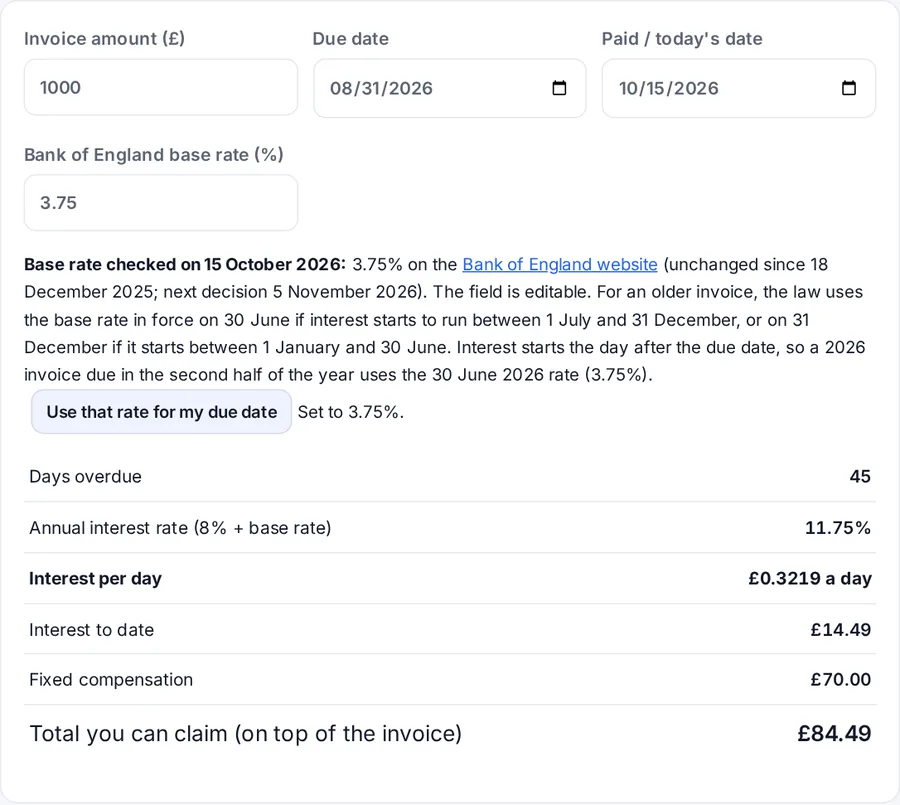
On a small invoice the fixed fee is the bigger number. On a £500 invoice that is 45 days late, the interest is only about £7.24 but the fixed sum is £40. On a large debt the interest soon dominates. Use the calculator to try your own figures.
When it applies, and when it doesn't
- Business to business only. It covers late payment by another business, including sole traders, and doesn't cover homeowners and other consumers. See chasing a homeowner for payment for that situation.
- Only once the invoice is late. If you agreed a date, GOV.UK says it must usually be within 60 days for business transactions (30 days for public authorities), and a longer period must be fair to both businesses. If no date was agreed, payment is late 30 days after the customer gets the invoice or after you deliver the goods or provide the service, if that is later.
- Not if the contract sets a different interest rate, as above. Read your contract or terms.
- Only on what is overdue. Work it out on the unpaid amount that has fallen due, not on the value of the whole job. If your contract allows a retention to be held back until a later date, that part isn't late until the contract says it is due.
What this means on a building site
Subcontractors often hear "we haven't been paid by the client yet". For construction contracts, section 113 of the Housing Grants, Construction and Regeneration Act 1996 makes a clause that makes payment conditional on the payer being paid by someone else ineffective, unless that third party is insolvent. There are exceptions to the Act, so check whether it covers your contract, but it is a good reason not to accept "pay when paid" as an excuse without asking.
The right to interest and the fixed fee sits alongside this. If you work for a contractor under the Construction Industry Scheme, your weekly invoice should still show a clear due date so there is no argument about when the clock started. See our weekly day-rate invoice guide, which has a full worked example, and invoice due dates explained.
How to claim it, step by step
- Check the basics. Is the customer a business? Is the invoice past its due date? Does your contract set a different late payment rate?
- Work out the figures with the calculator and check the base rate for your due date.
- Write to the customer. The calculator includes a free chaser letter that fills in the amount, interest and fixed fee. Keep a copy and proof that you sent it.
- Send a new invoice for the interest. GOV.UK says to send a new invoice if you decide to add interest to the money you're owed.
- Give a clear deadline, such as 7 days, and say what you will do next.
- If it still isn't paid, see taking an unpaid invoice to court for the next step, and how to chase an unpaid invoice for the friendlier steps first.
Be realistic about the relationship. Many subcontractors don't claim interest on the first late payment from a good customer, but still quote the right to claim it in a final reminder. If a large business pays you late, the Small Business Commissioner helps small businesses resolve payment disputes with larger ones. For a large or disputed sum, speak to Citizens Advice, a solicitor or your trade body.
Stop invoices going late in the first place
- Invoice every week on the same day, with the same layout. Contractors pay what is easy to process.
- Put a due date on the invoice, so there is no doubt when it fell overdue.
- Show labour and materials separately, so nobody delays payment to query the CIS deduction.
- Keep an eye on what is overdue. BillMyWeek highlights overdue invoices on your dashboard, and can send you a reminder when an invoice runs past its due date.
Frequently asked questions
What is the statutory interest rate on late business invoices?
8% plus the Bank of England base rate. The base rate used is the one in force on 30 June (for interest that starts between 1 July and 31 December) or on 31 December (for interest that starts between 1 January and 30 June).
Is the £40 fixed sum worth claiming on a small invoice?
Yes. The fixed sum is £40 for a debt up to £999.99, £70 for £1,000 to £9,999.99 and £100 for £10,000 or more. You can only charge it once for each payment.
Does statutory interest apply to a homeowner job?
Not under this Act. It covers late payment between businesses, so it doesn't apply to consumers.
Do I have to put the interest on the invoice first?
No, but GOV.UK says to send a new invoice if you decide to add interest to the money you're owed. The right to interest and the fixed sum arises by law once payment is late, unless your contract sets a different rate.
How much interest is that per day on £1,000?
At a 3.75% base rate the annual rate is 11.75%, so £1,000 × 11.75% ÷ 365 is about 32p a day.
Can a contractor refuse to pay me until their client pays them?
For construction contracts, section 113 of the Housing Grants, Construction and Regeneration Act 1996 makes a clause like that ineffective unless the third party is insolvent. There are exceptions, so check whether the Act covers your contract.
Sources
- Late commercial payments: charging interest and debt recovery – GOV.UK
- Interest on late commercial payments – GOV.UK
- Claim debt recovery costs on late payments – GOV.UK
- Late Payment of Commercial Debts (Interest) Act 1998, section 5A – legislation.gov.uk
- Late Payment of Commercial Debts (Interest) Act 1998, section 4 – legislation.gov.uk
- Late Payment of Commercial Debts (Rate of Interest) (No. 3) Order 2002, article 4 – legislation.gov.uk
- Official Bank Rate history – Bank of England
- Housing Grants, Construction and Regeneration Act 1996, section 113 – legislation.gov.uk
- Small Business Commissioner – GOV.UK
This guide is general information, not legal, tax or financial advice. Rules and rates change, so check the linked GOV.UK pages for the current position.